Monday, January 23, 2023

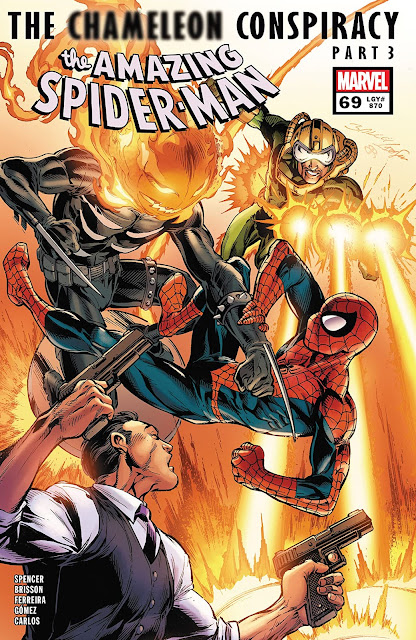
Amazing Spider-Man (2018) #67-69: Chameleon Conspiracy

 Amazing Spider-Man (2018) #67-69: Chameleon Conspiracy


   Spider-Man's life is obviously always complicated - and this chapter once again just serves to reinforce that fact. First of all, Ned Leeds is back. He took a ton of Goblin serum from his time as the hobgoblin and managed to survive a murder attempt. Second off, he knocked up Betty Brant. While Spidey doesn't know if he can trust him - yet, his sister Theresa Parker is being tormented by the Chameleon on the truth behind her parents' murder. Also, fellow Empire State University student Jaime still can't get that whole Clairvoyant doodad out of his life. The Finisher wants it but in the end,  Spidey and Ned save the day. Awesome stuff as usual from Nick Spencer and company.

For my previous Amazing Spider-Man review, click HERE

Thursday, January 19, 2023

Immortal Hulk (2018) #46-50

 Immortal Hulk (2018) #46-50
Of Hell And Of Death


   I've admittedly never been the biggest Hulk fan. His story is probably one of the most well known of all of Marvel/Stan Lee's creations. If you grew up anytime between now and 1970, you know that Bruce Banner turns into the Incredible Hulk and madness ensues, as the beastly Hulk can't control himself and lays waste to everything in his path.
   Many writers have spent time on the Doctor Jeckyl and Mister Hyde approach to Banner's overtold story and this series was similar in many aspects. But this one was different for a lot of reasons. Joe Bennett's artwork gives it a distinct vibe that kind of reminded me of Frank Miller's style. That combined with Al Ewing's stories really made this a different kind of Hulk book. In this final story, as the series wrapped with #50, Banner is in literal Hell. Joe Fixit is back as well as Alpha/Gamma Flight and even the Avengers all fight it out as they do their best to rescue Banner from the underworld, all the while freeing him from the Leader's grasp. Even Rick Jones makes several appearances, albeit in a very bizarre way. But honestly, I did enjoy this one. I'm sad to see it ending but a 50 book arc is very much enough to stand on it's own. I recommend reading this one from #1-50 if you have the time. You won't be disappointed. 

For previous of my Immortal Hulk reviews, click HERE


Wednesday, January 18, 2023

Fantastic Four (2018) #31-35

Fantastic Four (2018) #31-35:
 The Bride of Doom


   The Fantastic Four are invited to Doctor Victor Von Doom's wedding in Latveria, with Reed Richards being asked to be his best man. Only problem is that of course, loverboy Johnny Storm aka the Human Torch decides to have some hanky panky time with Doom's future potential bride, Victorious. Obviously this leads to issues with Sky, his fiance, who takes off back for her home plant.
   During the nuptials, she decides to come clean to Doom and tell him about her escapades which infuriates him. He decides to murder everyone but of course fails. One thing he does manage to do is turn Johnny Storm's flames permanently on with some kind of magic cosmic ray. 
   The final book of the story, issue #35 is the 60th anniversary issue and it's a doozy. A bunch of Kangs at the end of time decide to go back through various timelines to kill the FF. Eventually it's revealed that one of them is none other than Mister Fantastic himself. Through what amounts to a ton of pages, he eventually manages to lead his team over the Kang's and is victorious. The issue ends with Johnny still stuck in flame mode, but I'm sure solving it is right around the corner. 

For previous FF adventures, click HERE

Wednesday, January 11, 2023

White Noise (2022)

White Noise (2022)


from Roger Ebert.com: https://www.rogerebert.com/reviews/white-noise-movie-review-2022
Brian Tallerico December 29, 2022


Death unites us all. And societies are shaped by not just the dread of that inevitable outcome but the common manners in which we push those existential thoughts aside. Consumerism, conspiracy theories, and collective trauma collide in Noah Baumbach's daring adaptation of a novel that may have been published in the mid-'80s but undeniably speaks to the issues that continue to dominate our culture in the 2020s. A story of a family unmoored from their already fragile existence by an airborne toxic event has relevance to the COVID era that author Don DeLillo couldn't have imagined specifically. Yet, the source material here is designed to speak to a larger sense of trauma and fear—elements that will never go away as long as that pesky Grim Reaper remains in our lives. Baumbach's adaptation of "White Noise" unpacks these complex themes with a playful spirit for about 90 minutes before the writer/director arguably loses his grip on the more serious material in the final act. Still, there's more than enough to like here when it comes to the unexpected blend of an author and filmmaker who one wouldn't necessarily consider matches. Life is full of surprises, right?

"White Noise" opens with a professor named Murray Siskind (Don Cheadle) speaking of the comfort of car crashes on film. Like every choice in this script, it's not an accident. Siskind speaks of the simplicity of the car crash, noting how it cuts through character and plotting to something that's easily understood and relatable. It foreshadows the mid-section of a film that will play essentially like a disaster movie, asking viewers to imagine what they would do if stuck in the same situation. And it's a set-up for another fascinating aspect of "White Noise"—a commentary on crowd catharsis. We are at peace when we see others doing the same thing we are doing, whether it's watching a car crash in a movie, attending an Elvis concert, or buying things we don't need at an A&P grocery store.

Someone who keenly understands groupthink is Professor Jack Gladney (Adam Driver), one of the world experts on Hitler Studies, even though he's embarrassed that he doesn't speak German. The first act—and the film is divided into three parts on-screen—could be called a satire of academia as Gladney, Siskind, and their colleague use big words to help get a grip on big problems. Jack and his wife Babbette (Greta Gerwig) have a blended family that includes the anxiety-prone Denise (Raffey Cassidy), problem-solving Heinrich (Sam Nivola), and two more children. Babbette has forgotten things lately, and Denise notices a new prescription bottle for a drug called Dylar. This is an everyday American family—going through the motions of life as they try to push away the issues that have dogged philosophers for eons, like the meaning of it all and how to stop thinking about when it ends. In one of the best early scenes, a comment about how happy they are leads Babbette and Jack into a conversation about who should die first.

While death is a concern in the first act of "White Noise," it becomes more tactile in the second act, titled "The Airborne Toxic Event." A train crash at the edge of town sends chemicals flying into the sky, and everyone in the Gladney family except Jack panics. As he tries to defuse the situation, Denise becomes convinced that she's sick already, and Henrich obsessively listens to news reports. Before long, they're on the road in a mass evacuation, and one of Baumbach's most impressive technical achievements unfolds, capturing a family on the run from the unknown.

Without spoiling the final act completely, it re-centers the Gladneys back at home, but with death a much more present reality in Jack's mind. Unfortunately, as the intensity rises, "White Noise" loses some of its impact, especially in a few talky scenes near the end that betray the tone of the first half. Yes, the film always deals with "serious" subjects, but it gets rocky when they take center stage, and the tone struggles to merge satire and marital drama. DeLillo's book was notoriously called "unfilmable" for decades, and it feels like this last act is where that's most apparent.

Thankfully, Baumbach has two of his most reliable collaborators to keep it from going off the rails. Driver is, once again, excellent here, crafting a performance that is often very funny without relying on broad character beats. There's a version of this character that's pitched to eleven—the awkward academic forced into trying to keep his family alive despite his inferior skill set—but Driver gives a performance that's often very subtle even as everything around him is going broad. Gerwig is a little oddly mannered early in the film, but that makes sense for a character who becomes somewhat unmoored before the air around her becomes toxic.

To unpack this epic of existential dread, Baumbach has assembled a team that deserves mention. Cinematographer Lol Crawley ("Vox Lux") finds the right balance between realism and parody in his camera work, giving much of the film an exaggerated look amplified by Jess Gonchor's ace production design. The A&P here, with its bright colors and shelves of identical items, is not quite reality, but it's close enough to make its point, and the chaotic sequences of panic in the mid-section have the energy of a CGI blockbuster. Finally, Danny Elfman's score is one of the best of the year, connecting the three tonally different sections.

What does it all mean? Why do we take pills, buy junk, and watch car crashes to escape our fears? The phenomenal A&P dance sequence that ends "White Noise" lands a key theme in a fascinating way—we may all just be buying colorful stuff we don't need to distract ourselves from reality, but let's at least try to have fun while we're doing it.

Friday, January 6, 2023

Evil Season 2


from indiewire: https://www.indiewire.com/2021/06/evil-season-2-review-paramount-plus-1234645280/

Evil Season 2


Steve Greene
Jun 20, 2021 12:04 pm
@stevebruin

Believing in anything can be messy, so it only makes sense that “Evil” would be, too. The show, which debuts its Season 2 this weekend on Paramount+, fashioned itself as something of a belief kaleidoscope when its initial season aired on CBS proper in late 2019 and early 2020.

The show’s initial hook came from the pervasive-yet-cordial disagreements between Catholic Church assessor David Acosta (Mike Colter) and psychologist Kristen Bouchard (Katja Herbers), each tasked with working together to evaluate claims of otherworldly forces in the lives of people in and around New York. Each inexplicable phenomenon that they and universal skeptic Ben Shakir (Aasif Mandvi) encountered over the course of that first season was met with a range of theories stemming from steadfast doctrine adherence (the presence of malignant spirits bent on manipulating humans’ better instincts) to simple scientific explanation (usually an abundance of a household chemical only intended to be used in small amounts).

It would be easy to claim that Season 2 delivers more of the same, but that would undersell the extent to which these new episodes have a far greater dose of “more” than “the same.” After already building to something of a unified theory that tied most of the mysterious Season 1 occurrences together, “Evil” keeps some of that framework and spends the early going of this new season by adding rather than refining. Here be invocations in archaic languages, accidental amputations, and clear-headed confessions of felonies punishable by life in prison.

“Evil” is still a show concerned with contradictions, but it’s not the simpler “science vs. faith” tussle that may have been the hook at the beginning. It’s not just that Kristen and Ben and David have had their respective touches with the unexplained. (As of Season 2, all three have new reasons to question what they’re seeing with their own eyes.) There’s a certain threshold that’s been passed, a blurring between what’s meant to be real and what’s intended as mere perception. As frustrating as it can be at points from an episodic storytelling standpoint, there’s a certain method to that murkiness that puts the viewer on equal footing with the main trio whose perceptions of what to believe has been shifted by visions of avenging archangels, scythe-wielding devils, and disco dance moves from the unlikeliest of sources.

The challenge with this show is always going to be the balance between the big-swing maximalism of its supernatural elements and the quieter character moments it peppers throughout. When those two manage to sync up, like Kristen navigating the complicated realities of her marriage or David’s not-exactly-sanctioned efforts at communing with the sublime, it’s a thrill to have a show that can deftly handle both at the same time. The group dynamics, whether between our three main investigators or Kristen’s four daughters, grow stronger with each passing scene spent together. There’s a feeling of everyone becoming more comfortable around each other, even when the powers swirling around them are more of an enigma than they’ve ever been.

After settling into a groove at the end of last season, Season 2 takes a different enough tack that these opposing forces sometimes leave the show somewhat disjointed. “Evil” has plenty of characters that the series’ writers understandably are hesitant to give up, notably Leland Townsend (Michael Emerson). Fiendish and theatrical in hyper-controlled ways that seemingly only Emerson can tap into, he’s also one of the show’s convenient conduits for outlining what’s at stake. (“It’s so comforting to pray to power instead of weakness,” Leland says when describing his consorts with the Devil.)

Keeping him around is more a blessing than a curse, but the contortions that “Evil” has to make to keep him involved sometimes points to the show having the occasional hit-or-miss streak. If there’s any cause for concern, it’s that this season provides even more chances for “Evil” to go astray. After hinting at the end of last season that a fertility clinic could hold the key to explaining everything, “Evil” keeps adding on cases. So far the show has resisted using multiple episodes to really consider a single instance. If it continues at this pace, there’s a potential for burnout awfully quick.

Even if that comes, there’s still plenty of value in the way the show defies treating individual faith traditions as monoliths. It’s an antidote to the idea that invoking any particular deity (or a belief in the absence of one) should be an automatic justification for any course of action. Many of the show’s arguments bubble up from a theological starting point, but the “Evil” big tent approach draws in discussions of power, patriarchy, bigotry, the nature of righteousness, and the prevalence of modern surveillance tactics. Whether there’s enough real estate to yield any meaningful conversations or if those moments are blips on the way to tying up all the episode’s loose ends by the time 41 minutes are over remain in the eye of the beholder. (Of the first four episodes of Season 2, only the fourth is written by series creators and executive producers Robert & Michelle King. It’s also the one that feels closest to a full “The Good Fight” Season 4 crossover, though the two shows’ DNA are still recognizably linked.)

On some level, saluting the show’s elastic episode-to-episode approach means accepting that there’s a part of “Evil” that will always feel a tad elusive. The show has room for dissections of cognitive behavior, considerations of the ethics of certain Church practices, dalliances with prosthetic-covered dream demons, and a handful of psychedelics-induced hallucinations for good measure. It’s a combination that’s baffling in the best kind of way.

The deeper that “Evil” gets into its mythology, the more it feels like a magician offering an inside look at how they do their tricks. For those who enjoy “Evil” for its web of sigils and exorcisms, Season 2 still has plenty to offer. Peel back the layers of CGI apparitions and simple effects flair (each episode begins with an intricate pop-up book motif) and you still have the show’s simple, tiny unsettling touches: a shriek coming from a garbled voice recording or a strange noise happening just out of sight or a mirror staring back with a sinister grin. They’re all threads in a bizarre tapestry that maybe doesn’t always make sense when looking at it up close. But step back for a full view, and there’s nothing else like it on TV.

Grade: B+

Tuesday, December 27, 2022

Star Trek Picard S2


Star Trek: Picard - Season 2


By Scott Collura

Be careful what you wish for. What other lesson can we take away from this second (and also penultimate) season of Star Trek: Picard, which – let’s just say it up front here – might just be the worst season of Star Trek ever produced. Next Gen Year 1, take the party outside.

Look, when Patrick Stewart was announced to be returning to his iconic role of Jean-Luc Picard a few years back, it was more than any Trekkie could’ve hoped for. Captain Picard would finally get the ending he deserved! But now we’re two seasons into that ending, and it sure doesn’t feel like Jean-Luc, or any of us, have deserved this.

Season 1 of Picard was a mixed bag to be sure, as the series (and Stewart himself) sought to put a parsec’s distance between the title character and his Next Generation days. No uniforms, no starships, no Enterprise crew – these were more or less the mandates that enabled Stewart to return to space. Sure, there was some good stuff here and there, but the result was often a dour, dark, and just kind of confused affair.

And so Season 2 seemed to be attempting a course correction right out of the gate, with the opening scene of Episode 1 set on a starship in the midst of a battle. The first season’s cast – the Picard Squad – were mostly reconfigured into more likable, familiarly Star Trek-ian versions of themselves, even while Jean-Luc himself seemed to have a new lease on life. He’d accepted a role back at Starfleet Academy as Chancellor and was even circling a potential romance with Orla Brady’s Laris, a fan-favorite character from the prior season.

Oh, and TNG staples Q (John De Lancie) and Guinan (Whoopi Goldberg) were back in recurring roles. But again, and Q would know this better than anyone, be careful what you wish for…

After that fun Season 2 premiere, things began to take a turn for the tropey, if still enjoyable. Q’s meddling sends the Picard Squad to a dark, alternate universe? Check. The crew slingshots around the sun to travel back in time in an attempt to fix the timeline? Got it. Fish out of water hijinks ensue? Mmhmm. The Borg Queen is back… again? Yeah, that too. Uh, punk rocker with a boombox on the bus…? Checkkkkkk.

It’s as if the production, in reaction to Season 1’s distancing from the Treks that have come before, slingshotted too far around the storytelling sun to accommodate all the things we’ve loved about the franchise in the past. Unfortunately, as it unfolded, Picard Season 2 began to feel like nothing but a greatest hits album, and not just that, but one of those albums where it’s all covers of your favorite songs.

It seemed clear from the start that the writers wanted to undo a lot of what they were stuck with after the prior season. Core characters like Isa Briones’ Soji and Evan Evagora’s Elnor were effectively written out of the proceedings (though Briones would get yet another new character to play eventually, her fifth at this point). Brent Spiner’s fairly unremarkable Dr. Altan Soong was replaced with yet another Soong, this time the kind of screechy, hysterical, and sloppy Adam Soong (played by Spiner again). And even the budding relationship between Raffi (Michelle Hurd) and Seven (Jeri Ryan) that was hinted at in the Season 1 finale is in the post break-up stage when we rejoin them here.

That said, it was nice to see the gang again as the new season began, with characters like Santiago Cabrera’s Captain Rios and Alison Pill’s Agnes Jurati coming across as more likable versions of their Season 1 selves. But as the characters landed in the past, and it became clear that they were not heading back to the future, as it were, anytime soon (in an apparently budget-saving move), a sense of running in place overtook things. This included some characters heading out on multi-episode missions that, in the end, accomplished nothing. The heist-style infiltration of the big NASA ball comes to mind, where there’s a whole rigamarole about sneaking into this event. But ultimately the mission seemed to accomplish very little (and certainly didn’t require the whole Squad). But hey, at least everyone got to wear tuxes and fancy dresses.

As for Picard himself, I take no pleasure in saying that at times this season, Stewart seemed frail and perhaps over-taxed. Who knows what’s really going on behind the scenes, but the man is 81 years old. When we hit mid-season and got two episodes in a row where Picard was unconscious for most of one hour and then spent much of the next sitting in a chair, one had to wonder whether or not the legendary actor just needed a break.

Picard’s arc this season certainly had promise, and it works to a degree as the show digs into his childhood and the mental health struggles of his mother. Are these difficult memories, locked away so tightly that even he doesn’t fully remember them, the reason why Picard grew into the guarded, emotionally distant man that he was often portrayed as? The show seeks to tie his budding romance with Laris, and apparent inability to commit to that relationship, to the mysterious past that is slowly revealed over the course of Season 2’s 10 episodes. But it hits a wall in part because Laris herself is given such a short shrift, introduced in the premiere as she is and then basically shoved aside until the final moments of the finale.

Instead, Brady spends most of her expanded role this season as Tallinn, a Romulan “supervisor” charged with guarding Renée Picard, a family member of Jean-Luc’s from the 21st century. In a very TV-ish “identical twin from Texas” scenario, Tallinn inexplicably looks exactly like Laris, and is also a callback to the Gary Seven character from the Original Series episode “Assignment: Earth” (which itself is basically recreated in the Picard Season 2 finale). It’s a lot, and as the season wore on it increasingly seemed like the disparate story threads just couldn’t be tied together in any kind of satisfying way in the end.

As far as Guinan and Q go, the younger Guinan of the past, played by Ito Aghayere, brought a spark to the season whenever she’d show up, but she also never really felt like Guinan. And De Lancie’s Q is just adrift throughout with no clear direction, alternately devilish and funny, and sometimes, I dunno, faux scary? It is Q’s overarching story, which is supposed to be the entire reason why the events of this season take place, that seems to make the least sense. And hence, the season itself ends with a big shoulder shrug. And yeah, we’re talking Next Gen Season 3, late '80s shoulder pads.

In the end, it’s as if the stage has been cleared for the promised reunion of the Next Generation cast in the third and final season. How far things have come from Season 1 in that regard, eh? Rios stays in the past to be with his new love and her son. Jurati is now a Borg Queen who has lived for centuries, but also a nice Borg Queen. Briones’ latest character just leaves for the byways and highways of the galaxy with… Wesley Crusher, in a wasted and puzzling cameo. Presumably Elnor will be shipped out on the Excelsior in Season 3 to make way for Riker, Worf, Troi, and the rest. None of these character arcs feel particularly earned, alas, and more just an “ends justifying the means” situation.

So what was this all for? What did this extended trip to the year 2024 really give us in the Picard lexicon? Has it really been worth it to bring back Stewart for this? I truly hope Season 3 is amazing and we get one last Trek from Stewart and the TNG gang that makes this all a distant memory. But as this season has proven, you can’t just snap your fingers like Q and make good TV…

Questions and Notes from the Q Continuum:I got nothing.

Verdict

Season 2 started off in a good place, looking to amend some of the missteps of the show’s freshman year. But in attempting to embrace and celebrate the things that fans love about Star Trek, the show fell into the trap of regurgitating old concepts. Picard’s central arc focused on him unlocking the dark memories of his childhood and how those mysterious events of his past helped make him the emotionally guarded man he is today, and while this is an interesting development in the character’s story, it never quite gels. Meanwhile, the majority of the Picard Squad were seemingly doomed to run in place throughout the season, biding their time until they were written off the show entirely.

Tuesday, December 20, 2022

Dead To Me S1

Dead To Me S1


from Thrillest: https://www.thrillist.com/entertainment/nation/dead-to-me-season-1-recap

The 'Dead to Me' Twists to Remember Before Watching the Even Twistier Season 2

A quick refresher about what went down in the Netflix show's first season.
By Sadie Bell

There's a scene in Season 2 of Netflix's dark comedy Dead to Me where Jen and Judy, the messed-up protagonists played, respectively, by Christina Applegate and Linda Cardellini, are eating pie at a diner just hours after burying a body. "We are not in Snow White," says Jen. "This is fucking Scarface." When Judy says she's never seen that Al Pacino movie, Jen quips that she hasn't either and that "no girls have," which, although not true, sums up how these two middle-aged Laguna Beach women are at a complete loss with how to deal with the blood on their hands.

The critcally acclaimed series, created by Liz Feldman and executive-produced in part by Will Ferrell and Adam McKay, returns with even more twists. While Season 1 focused on boho drifter Judy's attempts to atone for being involved in the hit and run that killed Jen's high-strung luxury realtor husband, Ted — which she did to an overbearing extent by lying to, befriending, and moving in with Jen to the point of it all blowing up in her face — Season 2 finds Jen struggling to make a similar confession to Judy about having killed her ex-fiancé, Steve (James Marsden). Now that the total amateurs who've both committed felonies have to cover up their crimes, the comedic crime thriller veers into outlandish territory by ratcheting up the scandalous revelations.

The result is that Season 2 is even easier to guzzle than the glasses of win Jen's perpetually downing. But with so many plot points in motion, there's also a lot to remember from Season 1 that will help you as you watch the new episodes. 

How did Jen's husband Ted die?

Season 1 hinged on the hit and run that killed Jen's (actually kind of terrible, cheating) husband Ted, and left her a lonely, angry widow. The show is of course about how Jen's new BFF Judy was involved in the incident — but the details were pretty murky and only revealed near the end of the Season 1 finale. Judy was at the wheel, but as soon as the accident happened, she felt compelled to pull over and get help. But she wasn't alone in the car; Steve was riding shotgun, and yelled at her to drive away, and then afterward counseled her to act like nothing had happened. Given that Judy is at times too conscientious and that Steve is connected to money-laundering and the Greek mafia, it checks out that Steve would ultimately be most to blame for trying to cover up the incident.

Why did Jen kill Steve?

In the Season 1 finale, Steve came over to Jen's unannounced, looking for Judy in a rage after finding out that she'd told the authorities about his money-laundering scheme. At the time, Jen was also livid with Judy, having just learned that she was involved with the accident that killed Ted, which made it easy for her to talk to Steve despite his intrusion on her property. But by apologizing for Ted's death, Steve unintentionally revealed he was also in the car with Judy the night Ted died, which caused Jen to deduce that Steve had manipulated Judy into fleeing the scene. The two started to argue, with Steve making cruel comments about how Ted must have wanted to die, and Jen forcefully asked him to leave by drawing her dead husband's gun on him. And then something happened offscreen that led to the shot of Steve's dead body floating in the pool. While it's clear going into Season 2 that Steve is dead, that Jen did the deed, and that Judy is aware of Steve's death, since Jen called her over — but both Judy and the audience are in the dark about what exactly went down.

Did Jen kill him in self-defense?

Here's where things get confusing: Season 2 picks up immediately the morning after — but it's instead spent over scrambled eggs in Jen's kitchen rather than on detailing what happened the night before. Once the kids are off at school, Jen and Judy finally talk about Steve and Jen says she already told Judy what happened: Steve allegedly strangled her and she killed him in self-defense. It seems plausible, given that we don't know what really happened either. But flashbacks show that Steve only verbally provoked her and that he never actually laid his hands on her. And it turns out, Jen didn't use the gun she drew on him, but instead killed him by braining him with a bird figuring, the baptism gift Judy had given her son that is apparently very sturdy. With Jen and Judy's friendship in shambles but on the mend at the start of the season, this lie starts to eat at Jen, as she knows she isn't being truthful with Judy, or, of course, the authorities.

Are the cops finally onto Jen and Judy?

While Season 1 focused on how Ted's death affected Jen as she was grieving and the culprits trying to cover up what they'd done, you may also remember there was also an active police investigation involved. The detective on the case, Agent Ana Perez (Diana-Maria Riva), found Judy insufferable personally, but information disclosed by Judy caused the detective to circle in on Steve as the prime suspect behind Ted's death. In anger, Jen went to Agent Perez at the end of Season 1 to say that Judy had confessed to her, but the detective stresses she cannot arrest Judy due to an ongoing investigation into Steve. With Steve dead, though, things have gotten even more complicated, and leads the agent to suspect something's likely up with the two women who seem to be at the center of every SoCal tragedy.