Thursday, December 10, 2020

Away S1 Ep 10: Home

from Vulture.com
https://www.vulture.com/article/away-season-1-finale-recap-episode-10-home.html

Away S1 Ep 10: Home


Away Season-Finale Recap: Touchdown
By Maggie Fremont



Photo: Courtesy of Netflix

It’s Landing Day, Space Buddies! When Matt Logan started talking about how stressed and scared he was about the Atlas successfully landing on Mars because there are 42 steps in the landing sequence “and every single one has to go right,” my first thought was, here we go again. But that was immediately followed by the thought that the Atlas deserves a win and maybe after everything they’ve endured, this would be the one thing that goes smoothly. Don’t laugh! This show is about hope and optimism in the face of uncertainty and maybe it rubbed off a little. Is that such a bad thing?

Anyway, I’m happy to report that the latter is what happens. Let’s get real for a second: As much as Away wanted to stretch out the tension, there really was no way a series like this would get its astronauts that close to Mars and not have them actually land by the end of the season. The alternative would be so bleak! Away, for all its melodrama and sad people in zero gravity, is not bleak. That’s not to say there isn’t some drama leading up to the landing and some real tension — I didn’t realize how badly I needed to see those five touch down on the Red Planet, but there’s some real catharsis by the end of Away’s season one finale.

It’s easy to be a little harsh on Commander Emma Green, what with all the crying and second guessing and the crying again (and this comes from me, a crier!). It’s hard to watch the rest of her crew be so sure in their choice to be on Atlas and Emma, their leader, to, well, not be sure at all. But “Home” puts all the Emma haters on blast a little bit.

Emma’s clearly scared about the launch. We see her terrible nightmares about the Atlas going up in flames upon entry into Mars’s atmosphere, but her crewmates merely sense it. And after the last episode, any and all tension on the Atlas is even more heightened when Emma’s alone with Ram.

As the two pilots are prepping the ship, you can feel it between them. When Ram cracks a joke about there being a problem with the solar panels, Emma bites his head off even though it was objectively funny and I will not hear arguments otherwise. Finally, Ram has to bring up what he said. He’s sorry if he crossed a line by confessing his feelings for her (he definitely did!), but he thought he was going to die (he really did think that!). Emma lets him have it: Of course he crossed a line. She’s his commander and him having feelings compromises her ability to lead. She ends her little speech with, “whatever you feel for me, I do not feel,” which is extremely harsh. Ram’s hurt and embarrassed and has nothing more to say to Emma.

Emma floats off to deliver some more bad news, this time to Lu. CNSA has sent instructions for Lu’s big photo op. You’ll recall that there was an international agreement that Lu would be the first astronaut to actually step on Mars and she’ll be sending a picture of her on the Red Planet alone, with the Chinese flag. “Someone’s going to become more famous than Neil Armstrong,” Misha tells her. Well, maybe not if the CNSA has anything to do with it.

Lu’s instructions are to take the photo with her reflective visor down, so you can’t see her face. Both Lu and Misha get it immediately, it’s a motherland thing. “I do not exist,” Lu says. And then Emma reminds her that with this photo op, Lu has some “leverage.” She could force CNSA’s hand. What does she want? She wants Mei reinstated at Mission Control. Later, she gets a “we’ll see” response from CNSA, which she knows means it isn’t happening. She’s with Misha at the time, and he, who really has revealed himself to be such a softy, tells Lu that she doesn’t owe “the motherland” anything else than what she’s already given. “If they aren’t proud of who you really are, they’re just stupid fools.” Lu is in tears over the kindness her friend — yes, friend — has paid her. Remember when people actually thought they could keep work and personal separate on this mission?

Speaking of best buddies, Kwesi goes to see Ram, still alone in the command module. He wants to make sure his two pilots are speaking to each other since in a few hours his life will be in their hands. Ram spills: Emma told him that she feels nothing for him and that his feelings compromise her work. Kwesi’s like, uh, dude, both those things can’t be true. If Emma felt nothing, Ram’s feelings wouldn’t be compromising anything. Kwesi doesn’t know in what capacity, but he knows Emma loves Ram. He also reminds his buddy to cut Emma some slack today — she clearly loves all of her crewmates and feels responsible for their lives. “Just imagine what a burden that is for her today,” Kwesi says. Kwesi is not wrong! About any of it!

Things feel very in order for this landing, which probably gives you pause on this show, but guys, things really are going well. As they all suit up, Ram and Emma make peace. She wants to apologize, but he won’t let her. He also won’t let her take on the burden of their deaths. They all got each other here and they all would die for this mission. It’s not on her. Also, he reminds her to enjoy this moment, which is some advice they could all probably use. Yeah, yeah, probable death…but also, Mars!

After a prayer from Kwesi (requested by Lu, if you can believe it), the Atlas team is ready. On Earth, everyone waiting to hear that sweet, sweet touchdown confirmation assembles at NASA HQ in Houston — how cute to see Misha’s daughter and Kwesi’s mom chatting — and prepares to watch the live feed of the landing. It could go very badly! They even have NASA shrink Putney around, and I’m sorry but that is not reassuring!

The astronauts send messages to their families before initiating the landing sequence: Emma tells Matt and Lex that she’s proud of them, Kwesi thanks his mother for “teaching [him] to believe in possible things” (yeah, obviously I’m already tearing up), Misha tells his grandkids that their mom is the real hero (gah!), Lu tells her son to do what makes him happy, and Ram tells his brother they made it. Who knows what Emma is thinking, but knowing how hard this is for Ram, she reaches over and lovingly — lovingly! — grabs his hand. On camera! The show is sure to zoom in on Matt’s face at this moment, so you know if there’s a season two questions will be asked.

And then they’re off. The Atlas lands on Mars. If you’re not feeling something upon seeing the joy and relief these five feel as they’ve achieved not just their mission but their dreams, I cannot help you. Ram screams out, Misha and Kwesi are in tears, and Emma, and this is not a typo, makes a joke. And hey guys, when the five of them get down onto the surface of Mars, they discover Pegasus is there ready and waiting for them. How’s that for a little hope?

They string things out a little bit more on Earth — for one second I thought we’d know Atlas landed but Houston would lose contact and that would be the big cliffhanger, but again, that’s not what this show is about — and there are a few seconds where everyone thinks things have gone south before Emma’s voice comes on and says it: “touchdown confirmed.” The room erupts in celebration.

And then the first image from Atlas arrives from the surface of Mars. It is not, in fact, just Lu standing there covering her face. It’s all five of the astronauts standing together, visors up so you can see all their faces. A team. Whether or not Away is renewed for a second season, it is a fitting image to go out on.

Mission Control

• Travis and Veronica are engaged! I hope they get married on horseback. I know it’s a very minor subplot, but I’m invested.

• Lex doesn’t have CCM and she and Isaac love each other. Sorry but the teen stuff just doesn’t measure up to the space stuff in this episode. Landing day, you guys!

• Matt decides that to get his and Lex’s minds off the landing (and their faces away from all the reporters outside their house), they’ll get Melissa and Cassie and take Travis up on his offer to ride horses. Matt can tell something’s up with Melissa and it isn’t just that she’s keeping Lex’s secret about spending the night with Isaac. She’s short with Matt who keeps calling them a team, and after stopping herself from saying “I’m not your wife!” takes a breath and says “You really can’t see it?” No offense to Mel but, I really don’t think he could. He’s very cool about it after — “how you feel is how you feel” — and doesn’t want her to apologize. Basically, the opposite way Emma handles Ram’s feelings.

• “You might be the first real Martian.” I just cannot get enough of Misha and Lu’s friendship. Never enough!

• If there is a season two, there better be 100 percent more of Josh Charles staring longingly up at the stars because that is what a good astronaut spouse does. I have seen all the movies and I have held my tongue long enough on this issue!!

Wednesday, December 9, 2020

Fargo S1 Ep 3: A Muddy Road

from Vulture.com
https://www.vulture.com/2014/04/fargo-recap-season-1-blackmail-stavros.html


Fargo S1 Ep 3: A Muddy Road


Fargo Recap: Thornton in My Side
By Kenny Herzog


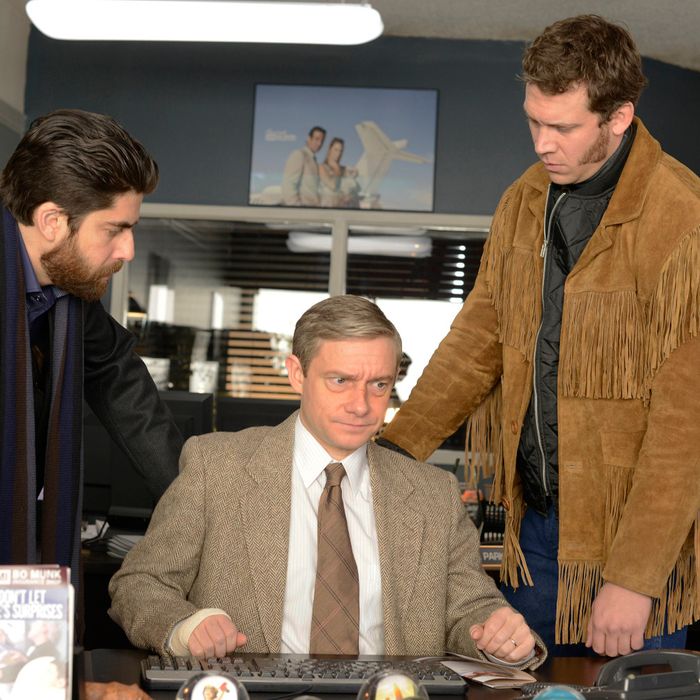
Photo: Chris Large/FX

Billy Bob Thornton fans who wanted more of Lorne Malvo’s fiendish antics last week should have had fun watching “A Muddy Road.” We know most of the players now, and the wheels are turning for their fates to intertwine or become further enmeshed. Puppetmaster Lorne has set his God-playing sights, for now, on regional supermarket monarch Stavros Milos (played by Oliver Platt). Lorne can’t stand this pig’s shallow grandeur, epitomized by the disharmonious artwork — a rudimentary self-portrait, vulgar stained-glass re-creation of St. Lawrence, and quasi–Pop art wall-hanging of an ice scraper — uglifying his home. So, Lorne figures, why not expense a run to the local butcher shop, make away with gallons of porcine blood, and mainline it into Stavros’s plumbing so he’s literally showered in Wilbur goo? Only after slicing his beloved dog Caroline King’s (genius) jugular and sneaking amphetamines into Stavros’s bottle of acetaminophen (we presume Milos has some migraine issues).

If Stavros wants to know whom he can thank for this latest streak of bad fortune, it both is and isn’t his wife’s idiot personal trainer, Don Chumph (the idiot-to-not-idiot ratio on this show is getting harder to keep straight). The lame-brained Squat Gym employee did attempt to blackmail his client’s spouse, but only for enough money to open a Turkish bath. He did not, however, rain Biblical hellfire. That was his new boss, Lorne, who saw through Don’s desperate ruse and inserted himself into the mix. This will not bode well for Don. After all, his surname does start with Chump. But along with some other relative Fargo innocents (Chief Bill, perhaps?), he seems ill equipped to survive Lorne’s Darwinian games.

But there are a couple of fellas not ready to lie down. One would be Gus Grimly, who comes mostly clean about his brush with Lorne to Duluth PD Lieutenant Schmidt (Peter Breitmayer). Schmidt, as Lou Solverson later notes, is “kind of a prick.” With daughter Greta in tow, Gus marches over to Bemidji PD and makes a full confession of what happened that icy night to an all-too-rapt Molly Solverson (good thing she was right there a-filing). She meets Greta, sizes Gus up as a sensitive dad, and moves past his cowardice. She’s also disinterested in the past, particularly when Gus reveals that Lorne was driving Lester’s stolen car that fateful evening, the very one Lester later asserted was in the shop. Gus, Molly, and Greta all share some diner grub at old Lou’s place, where it’s evident there’s a germ of romantic chemistry between the two officers, but more important, a common interest in vindication, no matter what their higher-ranking supervisors implore.

Anytime those two spend in pursuit of Lorne is good news for Lester, who in his own way has decided not to be some predetermined victim, an evolutionary gnat. Haunted by echoes of his crimes, he heads back to work at Bo Munk Insurance, looking to shed one skin and return to another, pleasantly duller past tense of Lester Nygaard. Only that ship, to reference how Molly describes her love life as “being married to the sea,” has sailed. Les hardly pops a squat when Misters Numbers and Wrench pay a visit, certain that he and Sam Hess’s widow, Gina, corroborated on Sam’s murder for the insurance money. It’s a reasonable guess, given how they’d just spied on Lester’s legit —  if awkward — visit to the Hess estate, where Gina plied him with whiskey and showed off her lap-dancing skills. Then again, Lucky Penny Lenny was a decent suspect, too, but just off the target. Those kinds of near-miss deductions must be commonplace in Bemidji, given Chief Bill’s knack for having cases half-right.

Lester, however, will not end up beneath the ice alongside Lenny. At least not without a fight. Like a hesitant disciple ready to bow at his master’s call, he arrives in younger brother Chazz’s basement, and the two finally bond over spent rifle shells and fantasy bloodletting. Only what Chazz doesn’t get is that, for Lester, this is basic training. Lester no longer sees the world in black-and-white, or through some kind of abstract filter that doesn’t allow for his essentialness. As his initial mentor, Lorne, once suggested, he sees things cavalierly now. It’s an outlook that, ironically, is a direct result of the tragicomic turns he willed life to take. By episode’s end, one wonders if Phil, the degenerate whom Lorne dragged to his trunk (and whose screen saver mirrored the philosophical fish poster in Lester’s basement) in an opening flashback, might relate. Too bad he couldn’t outlast the cold to say.

Apart from all that:

• Nice Pussycat Dolls remix at Squat.

• Lorne’s like True Detective’s Errol Childress — he wants the final confrontation.

• Meanwhile, Lester’s embarrassing return felt rather Don Draper–ian.

• Interested to see where this Sioux Falls business leads, how it ties in, and whether it brings Lou back into the fold.

• Even with Sam gone, Lester still gets bullied by his kids. Time is a flat circle!

• Oh, Moe.

• Really funny stuff from Minnesotan theater actress Anna Sundberg as Molly’s friend Patty.

• I love how literally everyone takes everything in this show. It just makes everything take that much longer.

• “So, which one makes the biggest hole?” is the new “We’re gonna need a bigger boat.”

• Now that Lou’s a gorilla, everyone’s proud of him.

Amazing Spider-Man #37-43: Threats and Menaces

 THREATS AND MENACES


Written by Nick Spencer
Penciled by Ryan Ottley and Iban Coello
Published Jan-May 2020

   Now seeking alternative employment, J Jonah Jameson finds himself at the new aggregate Threats and Menaces, a buzzfeed-esque sensationalist rag that decides to give the former Bugle editor his own podcast.  And his very first guest? None other than Spider-Man himself. In between the challenging interview, Chance is sent to beat the webslinger from the Palace. Thanks for allowing the Foreigner to be beaten by the house, the supervillain finds himself trying to throw the fight.
   Later, Spidey and new roomate Boomerang are forced to battle through midtown's sewers due to a rift between them and Mayor Fisk. There they run into Gog, an alien monster sent to Earth to scatter pieces of some.. thing. I don't know. Either way, they beat him and Spider-Man uses Pym particles to shrink him into being their new pet.

9/10.

Tuesday, December 8, 2020

His Dark Materials S2 Ep 3: Theft

from AV Club.com
https://tv.avclub.com/daddy-issues-multiply-in-his-dark-materials-land-of-da-1845779713


His Dark Materials S2 Ep 3: Theft


*****************

Daddy issues multiply in His Dark Materials’ land of daemons and dust


Photo: HBO


Myles McNutt


NOTE: While The A.V. Club’s coverage of His Dark Materials looked at the first season from both Expert and Newbie perspectives, we’ve moved to one review for the show’s second season. Be forewarned that there may be light spoilers for the books toward the end of the review and the potential for significant spoilers in the comments.


In the world of professional wrestling, each storyline is building toward a final showdown where two unstoppable forces meet in the ring to settle their differences. This is similar to all forms of media, of course, but there’s one challenge: Whereas most fictional narratives are able to build anticipation by keeping those forces naturally separated from one another to build anticipation, the conceit of professional wrestling is that it is a sport, and every wrestler is traveling from city-to-city and sharing locker rooms. It is only natural that they will come into contact before they eventually meet in the ring, and so wrestling has created conceits—live in-ring promos, diegetic interview programs hosted by wrestlers, contract signings—where combatants face one another without giving audiences the showdown they’re anticipating.

No, you haven’t accidentally stumbled into the wrong review of His Dark Materials, and I promise I won’t go down a rabbit hole about how limited contracts for stars like Brock Lesnar disrupted these types of narrative development (although those in this Venn diagram are welcome to discuss further in the comments). But I was reminded of these forms of narrative development when it became clear that “Theft” was contriving a situation where Lee Scoresby and Marisa Coulter would find themselves in the same town as they each searched for Lyra. It’s not as though their natural narratives led them to this point: Coulter’s zeppelin stops there unexpectedly, while a mysterious figure magically shifts the winds so that Lee makes a stop at the Samirsky Hotel looking for information. Of all the northern towns in all of this universe, they both happened to land in this one, and it delivers a confrontation that’s exciting—because the characters have never interacted before, and they’re two major characters in the show—but also a tease, knowing they will surely meet again along their journey.


This “contract signing”—here’s a wrestling example from a few weeks ago, if you’re curious—is meant to be revealing about both characters, and it certainly clarifies Coulter’s position in the story after her assertion of independence from the new Cardinal and the Magisterium last week. We’re meant to be skeptical about Coulter’s motives for Lyra after knowing what she willingly did to other children in the search of answers about dust, but we know that she loves her daughter, and the show has been doing more work than the books in clarifying that Coulter is a split-decision away from heroism when push comes to shove through a collection of small shifts in how the character’s point-of-view is articulated. And so while we don’t want Coulter to be the one to find Lyra, the story doesn’t want us to see her as an absolute villain, and her confrontation with Lee is about softening her edges: she is still willing to enact pain to get what she wants, but the conversation leans into the pain she suffered at the hands of her own parents, and her decision to set Lee free in the interest of knowing there’s someone out there looking for Lyra who cares about her is the clearest signal yet that her love for her daughter is more powerful than whatever else drives her.


I’ve long accepted that the show is committed to amplifying the duality of Coulter: They want to let Ruth Wilson loose to torture and manipulate, but they don’t want her to be a straight villain, and so they’re also heightening her love with Lyra. I would argue that a subtler approach to the character might have been more interesting, but Wilson plays both sides well, and I understand that the choice to adapt the book as a four-quadrant, all ages series may have dictated this choice. And I will say that I really appreciate the moment where, after Hester shared an intimate moment comforting Lee after the two characters had gone through the emotional wringer, the Golden Monkey offered its paw to Coulter in the closest thing they have to intimacy. While the expanded daemon budget has mostly been helpful for just making the daemons a visualized part of this world—the spider on the barkeep’s arm, for example—here we see one of the strongest scenes yet for the connection between human and daemon, and a nice bit of character development in the process. Although Coulter’s actual plot is unchanged by this detour to stumble into Lee—she’s still looking for Lyra, and still represents a threat—I ultimately liked what came out of it for her character.


I wish I could say the same about Lee. As I noted in the premiere, the motivation behind his quest to find Lyra has been pretty paper thin, and lacks the pathos of the book given that we’re seeing a much younger version of Lee, rather than a grizzled veteran foregoing retirement to protect a young charge. After a clunkily-choreographed encounter with a religious zealot at the observatory where Lee fires in self-defense and kills a man, his arrest pushes him to self-reflection, and when Coulter interrogates him he starts digging deep into his past. And frankly, I just don’t find the idea that Lee’s driven by “Daddy Issues” interesting or really that convincing. I realize that it pushes the surrogate father dynamic with Lyra, but Lyra already has actual complex relationships with parents, and I don’t think a rote “my father beat me up when I was little” does much to make Lee’s journey more interesting. It’s another piece of evidence that while Lin Manuel-Miranda’s casting may have been the clearest signal the show’s version of Lee was headed in a different direction, the real issues have rested on simply not calculating how to translate the Once Upon A Time In The North version of Lee into the narrative fabric of the main books.

Photo: HBO


The rest of “Theft” sticks largely to the books with that main narrative, as Lyra returns to Will’s Oxford to discover that news of her and Will’s adventures are starting to spread: not only is there a mysterious figure—maybe a police officer, maybe not—at Mary Malone’s office looking to ask Lyra some questions, but she escapes his grasp only to fall into the hands of Lord Boreal, who takes advantage of her panic to steal the alethiometer. It’s a sequence of events that depends on the fact that Lyra is still a kid, in a world that isn’t her own, and her stumbles place her and Will in more danger. And while Lyra has been alone before, she’s always been in a world where she had protectors, and the only person from her world who knows where she is is the same man who’s blackmailing her with the alethiometer in hopes they will secure him what he really wants: the knife in the possession of the shadowy figure inside the tower in Cittàgazze. And while I deeply miss the literary device of Latrom being revealed as Boreal to the audience and Lyra at the same time (which, like the Arstan Whitebeard reveal in Game Of Thrones, may just have never been feasible in a visual medium), I do appreciate how much the energy of Will and Lyra’s situation changes: Ariyon Barake does a great job of flipping the switch when he reveals his identity, referring to Will and Lyra by their names and shoving them headlong into a new conflict.


Photo: HBO

Mary spends the episode trying to tap into whatever Lyra was able to pull out of “The Cave,” and when she consults the I-Ching she discovers that the universe will surrender “to the mind that is still.” And the truth is that this is difficult in this story: there’s a lot going on, and finding the focus necessary to tap into the greater truths of the universe isn’t going to come easily. The principle of “Theft,” ultimately, is His Dark Materials resting for a moment: Coulter and Lee run into each other on a stopover on their respective journeys, and Will and Lyra’s movie date does feel like a breath of sorts, lest we forget that there’s nothing to these characters’ lives between tough scrapes and close escapes. I don’t think the breath accomplished much for Lee, unfortunately, but it mostly worked for the other characters, and the momentum generated feels substantial enough to warrant optimism regarding the rest of the season.
Stray observations
We got a bit more clarity in terms of what happened with the bombing of the witches last week, although all they really confirmed was that some witches did die: we still don’t really know why they couldn’t just smoke monster away, so I still think that was some shoddy storytelling.
While the new budget meant that we got a great aerial view of the landscape around the Saminsky Hotel, the show has largely not chosen to explore the frisson among the population of Lyra’s world at how Asriel opening a door to other universes created an aftershock of climate change. We get a bit of exposition from Iorek—there’s not enough ice or seals for his kind of survive—when Serafina’s daemon visits him to learn more of Lyra’s fate that night, but that’s one piece of the puzzle the show is not doing much to articulate.
That said, I will say that there is a fundamental limit to the number of scenes of other characters talking about Lyra’s prophecy that I can take in a given season. It really doesn’t add much to anything, and just seems like exposition for the sake of keeping the audience primed to the concept. Happy to see Iorek, wish that drop-in felt more meaningful.
Will takes a really long time to find Lyra’s note, suggesting that he didn’t find time to binge watch Arrested Development before the whole running away from home thing.
I don’t know why a movie theater was showing Paddington unless this is a period piece, but I can only applaud their choice, and also admonish Will and Lyra for some truly terrible movie theater etiquette. Just because I haven’t been to a movie theater in nine months doesn’t mean that I wasn’t aghast at the blatant talking and phone use during the movie. The disrespect to those other patrons and to Padidngton himself is unconscionable.
Just as a reminder, I know that the U.K. is a full eight days ahead, so please try to avoid alluding to or outright discussing events from future episodes if you’re watching on that schedule. This is as much for me as it is for everyone else, just to be clear.

Through The Amber Spyglass (More spoilery discussion of the books)

Everything about Lee as a surrogate father does track if they’re going to be expanding his story with John Parry—it’s already significant, of course, but the slightly expanded role for Lee as they try to build out the different narratives and balance the story differently will put more emphasis there, and the idea that you have Will’s actual father and Lyra’s father figure there does sort of track. I just wish it was more interesting to Lee as a character, instead of feeling manufactured to serve Lyra’s story.

The other book-reader thing that struck me here was how differently Will’s narrative plays out when it isn’t being discovered by Lyra and the reader at the same time. When you’re introduced to Will’s story at the start of the second book, it pushes us to think about Will mostly as a lens into Lyra’s own story, thinking about what his experience adds to her own and to the narrative as a whole. Here, however, we’ve experience Will’s narrative concurrently with that, and so as the story shifts into his quests—the knife, finding his father—I will be interested to see how audiences respond to what in the books was an integration of Will into a larger narrative, and here is theoretically the payoff to the time spent on Will in the first season. His acquisition of the knife is going to be a really interesting pivot point between those two audience perspectives.
Myles McNutt
PostsTwitter

Contributor, A.V. Club, and Assistant Professor of Communication at Old Dominion University.


Monday, December 7, 2020

Hillbilly Elegy

 from RogerEbert.com
https://www.rogerebert.com/reviews/hillbilly-elegy-movie-review-2020

Hillbilly Elegy

"2 1/2 Stars"
Matt Zoller Seitz November 24, 2020


Powered by JustWatch

The film version of J.D. Vance's memoir "Hillbilly Elegy" arrives on Netflix so encumbered by cultural baggage and expectations that it's hard to appreciate what it actually is—along with the things it does well, which are numerous, and understated enough to vanish in the haze of the zeitgeist. It's not a great or even particularly distinctive movie, but it's heartfelt and plain-spoken enough that it might connect with viewers whose families have dealt with addiction and recovery, domestic abuse, financial deprivation, and other problems highlighted in the story.

Jumping between 1997 and 2011, often incoherently, "Hillbilly Elegy" is another entry in a sub-genre that could be labeled "Getting Out"—the story of a sensitive, intelligent, often creative person who grew up in deprivation and disharmony, amid generations doomed to repeat destructive cycles of behavior and never leave the place that formed them. It's a durable mode of storytelling represented by countless notable films, from "I Vitelloni," "Mean Streets" and "Cinema Paradiso" to "Boyz N the Hood," "Girlfight," "Real Women Have Curves" and the recent "Mickey and the Bear" and "Them That Follow."

Played as an adult by Gabriel Basso, and as a teenager by Owen Asztalos, J.D. is an eloquent, honorable, decent-souled kid from a dead-end town who will end up attending Yale Law School and finding love with an Indian-American law student named Usha (Freida Pinto, doing the best she can in a supportive girlfriend role that's literally phoned in due to the hero's travel schedule). But even as life successes accumulate, J.D. remains constrained by his culture (working-class-to-poor white, mired in unemployment, and at risk of addiction). Things come to a head when, the day before an interview for a summer law clerk job that could fund his next semester, he's called home to deal with his mother Bev (Amy Adams), an addict who's been in and out of rehab for addiction and just survived a heroin overdose. The past is never past, especially where family is concerned: that's the closest thing to a message that this film is genuinely interested in.

The Vance clan hails from a small mountain town in Northern Kentucky. It's the kind of place where families hold onto totaled cars to strip for parts, and neighbors warn kids headed to the local swimming hole to watch out for poisonous snakes. J.D. uses a distant connection to the Hatfield-McCoy feud at a supper with well-heeled Yalies, literally dining out on a stereotype. He somewhat hates himself when he does this, but figures cultural currency, like the paper kind, might as well be spent. J.D.'s grandmother Mamaw (Glenn Close) made it out a couple of generations earlier and settled in Middletown, Ohio, the type of once-thriving factory town that Bruce Springsteen wrote lots of songs about. But the change in scenery didn't break the cultural cycles that defined her: Mamaw fled a background rife with domestic violence only to get into an abusive relationship herself, and her daughter's addiction has made the next generation's life a living hell. 

What's interesting here is that the filmmakers seem to have made a conscious decision not to explain any of this stuff to people who might not already know about it. Directed by veteran Ron Howard—probably the closest thing to an Americana specialist still working in big-budget mainstream dramas—"Hillbilly Elegy" has little interest in making sweeping statements about the historical roots of white, working class, Republican Rust Belt grievances against so-called "Blue America." 

That was the source of the book's appeal in the aftermath of Donald Trump's election—the thing that made it a surprise bestseller, and a sort of Rosetta Stone for media pundits trying to understand what happened. It's understandable that the movie version might strike some viewers as evasive for subsuming Vance's wider canvas (whatever they thought of its accuracy) to the subtext of characters' conversations and decisions. The editing sometimes cuts quickly between present-day Middletown, with its boarded-up storefronts and shuttered manufacturing complexes, to earlier eras when there was a sense of economic possibility. When J.D. finds out that his mother is about to be kicked out of the hospital and needs to find an open bed in a recovery facility as soon as possible, he tells family and friends, and their suggestions testify to their own firsthand experience dealing with this problem.

The poker-faced approach often backfires, particularly when "Hillbilly Elegy" focuses on the life of Mamaw, a compassionate yet hardbitten, insult-spewing force of nature. Close's curly wig, huge glasses, deglamorizing makeup and brazen performance choices (Mamaw has a lit cigarette in her mouth at all times, even when stocking a pantry) have been accused of insensitivity or Hollywood caricature. But I suspect this may be a case where Howard, screenwriter Vanessa Taylor, and the cast and crew were so determined to be perceived compassionate that they dried out the inherent absurdity of the situations. 

A more challenging (though sure-to-be-controversial) approach might've landed the film in a zone similar to "Precious: Based on the Novel Push by Sapphire," where you weren't sure if it was appropriate to laugh at the borderline-gothic situations depicted onscreen even though the audience around you was roaring. Here's the thing, though: it's actually OK to laugh at outwardly ridiculous real-life horrors as long as you understand and appreciate the circumstances—particularly when it's "your people" who are being depicted, which turns the experience into something intimate, shared and cathartic. Howard and company are tourists here, though, so it's understandable that the movie wouldn't have the nerve to put its foot down on the tonal accelerator and veer  into black comedy and surrealism (even though the movie occasionally cries out for that approach—particularly in a flashback where young Mamaw sets her abusive drunk husband on fire in front of a Christmas tree while "O Holy Night" plays on a radio).

I don't want to invalidate anyone's take on how believable or empathetic the portrayal of Mamaw is, because everyone's mileage will vary. But it's worth pointing out that the obligatory credits scroll of real-life photos of the fictionalized characters confirms that Mamaw did indeed look just like that—and that a friend who grew up poor and white in small-town Arkansas and watched this film with me gasped when Close first appeared. "Oh my God," she said. "It's my grandmother, except for the cigarette." 

Likewise, Adams' performance has been dinged for its unmodulated desperation and histrionics, but I felt stirrings of recognition watching her scenes opposite the elder and younger J.D., having dealt many times with a family member whose life is wreck for the same reasons as Bev's. Addicts who are constantly bottoming out, flirting with recovery, and going back to their destructive behaviors aren't known for subtlety. 

Although the hero J.D., as written and performed, is dull—this is not a knock against either of the actors, who are doing what the script and director required of them—the dullness is integral to the hero's relationship with most of the characters back home. It's the rocklike, reactive nature of J.D. that makes his escape plausible. Some of the early screenwriting details lay on the "country man vs. the elites" details rather thick—is it really believable that this guy would've gone all the way to Yale Law School without learning which utensil to use for which course, or that there's more than one type of white wine?—but the actors sell it, and Howard's subdued yet borderline-mythologizing approach to J.D. is part of a long snobs-vs.-slobs tradition in American film. I like that the story ends on a slightly unresolved note (immediately spoiled by title cards telling you what happened to everybody), with the hero taking stock in everything he's tried to do for his mother and their extended family, and figuring how far he can extend his compassion before it breaks him. It feels realistic and right, and validates something we know to be true: you can't save others if they won't save themselves.

I wanted a bigger, bolder, more imaginative take on this material than "Hillbilly Elegy" is willing or able to deliver. But there's still a lot to like here—particularly the way Howard and his collaborators keep reminding you that the same incantatory defense mechanism that allows people to endure rotten circumstances—family is everything, and relatives always stick together—is what cements their bondage to dark forces in their lives. At key points in the films, characters are given a choice to do the morally or legally correct thing or stick by their kin while the kin are right there looking on, waiting for the decision. The closeups of the relatives foretell the choice before it's been made. Family ties bind.

Available in select theaters today and on Netflix on November 25th.

Matt Zoller Seitz
Matt Zoller Seitz

Matt Zoller Seitz is the Editor at Large of RogerEbert.com, TV critic for New York Magazine and Vulture.com, and a finalist for the Pulitzer Prize in criticism.

Sunday, December 6, 2020

Murder on Middle Beach S1 Ep 3: Sisters

 from Meaww.com
https://meaww.com/murder-on-middle-beach-episode-3-preview-barbara-hamburg-sister-conway-beach-daughter-ali-suspects


'Murder on Middle Beach' Episode 3: Focus turns on Barbara Hamburg's sister and daughter as Madison investigates

As Madison's investigation continues, he discovers that the rift he noticed in his family after his mother's death, may have been there from long before


                            'Murder on Middle Beach' Episode 3: Focus turns on Barbara Hamburg's sister and daughter as Madison investigates
Barbara Hamburg (HBO)

HBO's four-part docuseries, 'Murder on Middle Beach', delves into the gruesome murder of Barbara Hamburg, a 48-year-old woman, who was found bludgeoned to death outside her home on Middle Beach Road. Directed by Barbara's son, Madison Hamburg, the docuseries is a chronicle of Madison's return to his home as he is determined to understand the life of the mother he had lost and to uncover the truth about her death. The family's troubled history is explored and Madison questions whether learning the truth will provide closure or just more grief.

In the first episode of the miniseries, we see Madison explore the possibility of his father, Jeffrey Hamburg -- Barbara's ex-husband -- being a potential suspect for the murder. On the day that Barbara was found dead, she was scheduled to appear in court to discuss ex-husband Jeffrey's claim that he could not afford to pay child support and alimony. The pair had divorced in 2002. When Barbara failed to show up in court, her lawyer called the Madison police to check her address when they found her body in the yard. However, Jeffrey had a strong alibi and was not charged.

In the second episode, Madison finds out more about his mother's involvement with the Gifting Tables pyramid scheme where, in order to join the scheme which was marketed as a sisterhood, women had to pay large sums of money to existing members and then they would recruit others so that they themselves could eventually receive their own "gifts." A new member would enter into a four-level pyramid with tiers named 'Appetizers', 'Soups and Salads', 'Entrees' and 'Dessert', according to the Department of Justice. Madison explores the possibility that one of Barbara's victims may have killed her.

In the third episode, however, Madison's circle of investigation comes back to his family, with the two women closest to his mother being under the lens. One is Conway Beach, who was once the closest to Barbara among her sisters. However, Conway's alcoholism drove a wedge between them and certain events led to Conway even planning at one point to get rid of her sister. Conway speaks to Madison in the third episode about her relationship with Barbara and what led her to want her sister dead and what brought them back together.

On the other hand, there is also the possibility of Madison's sister, Ali Hamburg being the one responsible for Barbara's death. While no one else blames or even suspects Ali, Conway strongly believes her niece to be the real killer of Barbara. This week's episode also features her telling Madison why she thinks so, and whether Ali could have really been the one to murder her own mother.

As Madison's investigation continues, he discovers that the rift he noticed in his family after his mother's death, may have been there from long before. He also realizes that his mother may not have been as he remembers and gets his family's accounts of who his mother really was. 

'Murder on Middle Beach' airs on HBO on Sunday nights at 10/9c.

If you have an entertainment scoop or a story for us, please reach out to us on (323) 421-7515